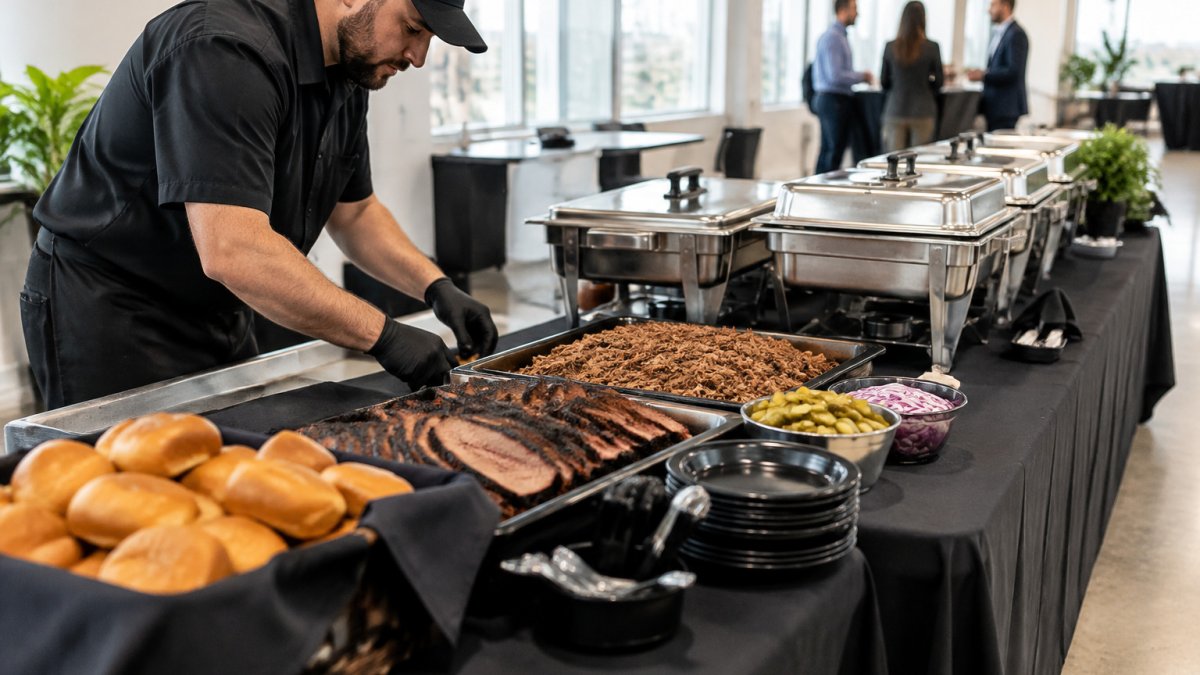
 Ultimate guide
Corporate Catering Setup and Cleanup: What to Expect
Last Updated: November 22, 2026
Quick Summary
Corporate catering setup and cleanup covers the physical work between food delivery and the last guest leaving: arranging tables and food stations, serving the spread, then breaking down equipment, packing returnables, and restoring the room. Scope varies by provider, so confirm in writing which tasks, equipment and labor hours are included before booking.
- Full-service crews arrange tables, stations and presentation, then break down and pack out after the event.
- Drop-off orders leave setup, replenishing and cleanup to your internal team.
- Plan arrival 60 to 90 minutes before service for a staffed buffet.
- Confirm cleanup responsibility, trash disposal and rental pickup in writing before signing.
- Compare quotes by all-in total divided by confirmed guest count, not the headline per-person rate.
Table of Contents
- What Corporate Catering Setup and Cleanup Services Include
- Full-Service Versus Drop-Off Catering: How to Choose
- Corporate Catering Setup Checklist for Office Events
- Setup and Cleanup Timelines: Before, During, and After the Event
- Office Catering Cleanup: Who Is Responsible for What
- Corporate Catering Cost: What Drives the Price
- Corporate Catering Event Planning: Guest Count, Menu, and Logistics
- Booking Your Office Event With Barbells & BBQ
- Frequently Asked Questions
Corporate catering setup and cleanup services are the difference between a lunch that runs smoothly and one that leaves your team scrambling. Below, we break down what a full-service crew handles, how it differs from a drop-off order, and what to confirm before you sign anything. (Source: FDA Food Code)
Start with the scope question, because "catering" means very different things to different providers. A quote for a 60-person lunch might cover the food only, or it might include tables, serving equipment, a crew that sets the spread, and a team that breaks it down afterward, depending on the provider.
What Corporate Catering Setup and Cleanup Services Include
Setup and cleanup are the parts of an event that never appear on the menu but determine whether guests notice the food or the logistics. A complete service typically covers the physical work between delivery and the moment the last guest leaves, and the boundaries of that work should be defined before the event.
Setup: Tables, Food Stations, and Presentation
Setup starts with the space itself. The crew places serving tables, lays out food stations so traffic flows in one direction, and arranges the buffet or plated service in a way that keeps lines moving.
Confirm whether linens, serving utensils, chafing dishes, and disposable or reusable serviceware are included. Some providers bundle these; others list them as rentals. Clarify the setup window too, since a crew that arrives well before service has more room to arrange a clean presentation.
Cleanup: Breakdown, Packing, and Venue Restoration
Cleanup covers what happens after the last bite. Typical tasks include clearing and washing serviceware, breaking down tables and chafing equipment, packing leftover food and returnables, and resetting the room as close to its original state as possible.
Define responsibility in writing. Does your office team clear the tables, or does the crew? Who handles trash removal, and where does it go? A clear answer prevents the common scenario where the caterer packs up and leaves the conference room covered in napkins.
Full-Service Versus Drop-Off Catering: How to Choose
The core decision is whether you need people on site or just food at the door. Each model has real trade-offs, and the right choice depends on headcount, formality, and how much internal labor you can spare.
| Factor | Full-Service | Drop-Off / Delivery Only |
|---|---|---|
| Setup | Crew arranges tables and stations | Food arrives in disposable or semi-disposable trays |
| Serving | Staff serve or monitor the line | Guests serve themselves; team handles replenishing |
| Cleanup | Crew breaks down and packs out | Internal team usually handles it |
| Best for | Client meetings, executive lunches, large events | Simple team lunches, informal get-togethers |
| Cost | Higher, reflects labor and equipment | Lower, fewer line items |
Pros of full-service:
- Professional presentation that reflects well on leadership and clients
- No internal staff pulled away to set up or tear down
- Cleanup is handled, so the office is back to normal quickly
Cons of full-service:
- Higher total cost because you pay for labor, equipment, and time on site
- Less flexibility if plans change last minute
- Requires clear communication about access, parking, and load-in times
Pros of drop-off:
- Lower cost for groups where presentation is secondary
- Simpler ordering and fewer logistics to manage
Cons of drop-off:
- Your team manages setup, replenishment, and cleanup
- Food may sit out longer without someone monitoring temperatures and refills
- Less polished for anything involving clients or senior stakeholders
A 25-person company holding a casual Friday lunch often does well with drop-off. A 150-person employee appreciation event almost always needs full service. Most fall somewhere between, and that is where asking the right questions pays off.
Corporate Catering Setup Checklist for Office Events
Use this checklist when you are comparing providers or preparing your own team for the day:
- Confirmed headcount with a buffer for late additions
- Setup window agreed upon, with arrival time and access instructions
- Tables, linens, and serving equipment listed as included or rented
- Food station layout reviewed so traffic flows without bottlenecks
- Dietary needs and allergens labeled clearly on every item
- Power, outlets, or hot-holding requirements confirmed for the space
- Parking and loading zone identified for the catering vehicle
- Named point of contact on both sides for the event day
- Cleanup responsibility and trash disposal confirmed in writing
Setup and Cleanup Timelines: Before, During, and After the Event
Timing is where office catering goes wrong most often, and the fix is to build the schedule backward from the moment you want guests to eat. The windows below reflect common full-service practice; confirm your provider's actual numbers in writing, because venue access rules can stretch every one of them.
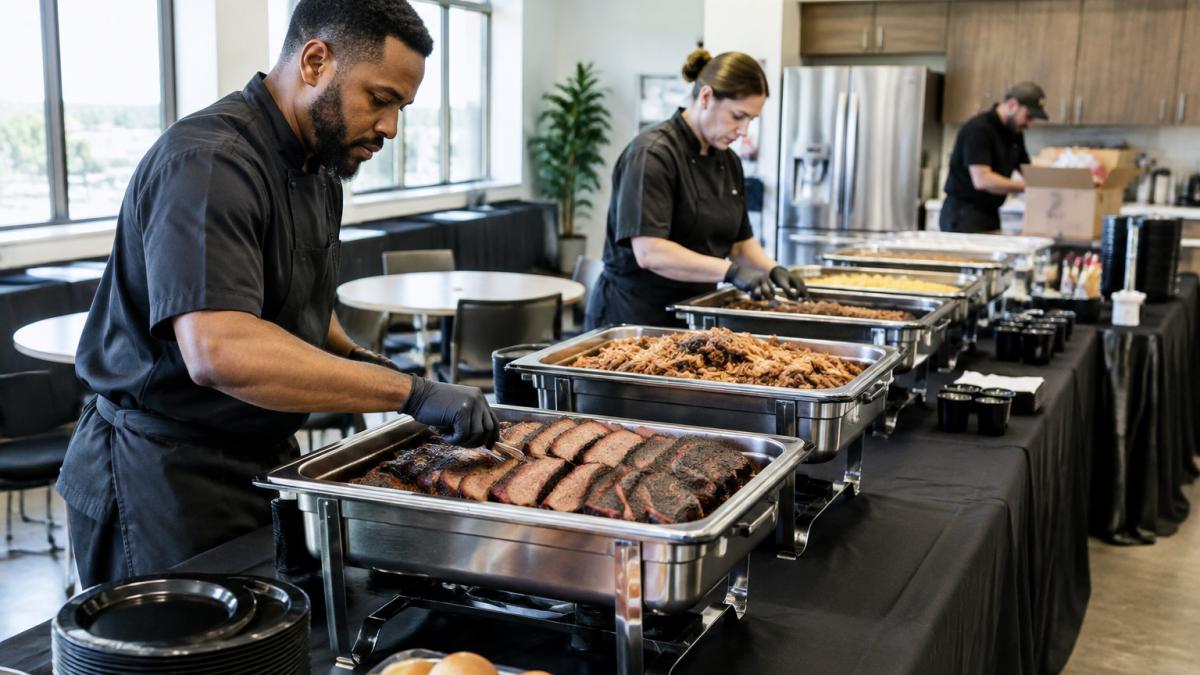
Arrival and setup windows by service style
- Drop-off: arrival 15 to 30 minutes before the service window. Setup is limited to placing trays and, if included, setting out serving utensils. No crew stays.
- Setup-only: arrival 45 to 60 minutes before service. Crew arranges tables, lays out the spread, and leaves once the line is ready.
- Staffed buffet: arrival 60 to 90 minutes before service. Crew sets tables and stations, holds hot food at temperature, and stays to monitor and replenish the line.
- Plated service: arrival 90 to 120 minutes before service, sometimes more for a multi-course menu. Crew sets tables, stages plates, and coordinates course timing with your program.
Add 15 to 30 minutes to any window if the crew must use a freight elevator, wait for a building escort, or navigate a security check-in. Share those constraints with the provider when you book, not on the morning of the event.
The service window and what happens during it
Service timing is driven by your agenda, not the caterer's preference. Tell the provider when remarks, awards, or a meeting segment will interrupt the line, because a buffet that opens during a speech sits and cools. For a typical 60-minute lunch, plan the line to open within 10 minutes of the scheduled start and keep it open for 30 to 40 minutes, then close it before dessert or cleanup begins. Staffed service includes replenishment and temperature monitoring during this window; drop-off does not, which is why food can sit out longer without someone watching it.
Breakdown and venue restoration
Breakdown begins as soon as the line closes. For a mid-sized event, plan 30 to 60 minutes for clearing, packing, and resetting the room. Larger events, plated service, and venues that require equipment washing on site push toward the longer end.
Venue restoration is the step most often left vague. A full restoration typically includes wiping serving surfaces, removing catering trash, breaking down tables and chafing equipment, and returning furniture the crew moved. It usually does not include clearing guest trash from common areas, vacuuming carpets, or returning furniture the crew did not move.
Post-event pickup and equipment returns
Rentals do not always leave with the crew. Some providers pick up equipment the same day, while others schedule a next-business-day pickup. If your venue charges for storage or requires the room to be empty by a certain hour, same-day pickup matters.
Watch out: a crew that cannot get back into the building after hours may leave rentals staged in a hallway overnight. Confirm the pickup window against your building's access rules before you sign.
A backward-planned schedule you can copy
Start with the guest arrival time and subtract: 10 minutes for final setup checks, the setup window for your service style, and the load-in and access time. Then add forward from the line close: breakdown time, restoration time, and pickup window. Share the resulting schedule with your internal team and name one person responsible for door access, one for directing guests to the line, and one for holding the cleanup area clear. A schedule that exists only in the caterer's confirmation email tends to fail on the day.
Office Catering Cleanup: Who Is Responsible for What
Cleanup disputes are almost always about unstated assumptions. The most useful way to avoid them is to split responsibility into three buckets and confirm each one:
- Caterer responsibilities: breaking down their own equipment, packing returnables, removing their food waste, and washing serviceware if included in the package.
- Host responsibilities: clearing guest trash from common areas, returning furniture to its original position, and providing access to a sink or dish area if required.
- Shared responsibilities: anything the contract leaves vague, such as wiping tables after guests leave or sweeping crumbs. Settle these before the event.
If your office has a loading dock or freight elevator, mention it upfront. Crews plan their breakdown around access, and a locked service door can add an hour to cleanup without anyone intending it.
Corporate Catering Cost: What Drives the Price
Catering quotes for the same headcount can vary considerably, and the difference is often less about the food than about labor, equipment, and access. It is labor hours, equipment, access, and how the provider defines cleanup. Understanding the mechanics behind each line item lets you compare quotes on equal footing instead of comparing per-person headlines.
The five line items that move the total
1. Labor hours, not just staff count. Full-service pricing is often built around staff count, hours on site, and labor rates, along with any coordination fees.
**2.
3. Rentals and disposables. Linens, chafing dishes, serving utensils, plates, and flatware are either bundled into the per-person rate or billed as separate rentals.
4. Delivery distance, timing, and access. Delivery fees typically scale with distance and with time of day.
5. Menu complexity and dietary accommodations. Multiple proteins, carved-to-order stations, plated courses, and specialty dietary options each add prep time and, often, separate equipment.
How to compare quotes without getting burned
Request an itemized quote that separates food, labor, rentals, delivery, and any setup or cleanup fees. Then normalize the quotes: divide the all-in total by the confirmed guest count and compare that number, not the headline per-person rate. Ask each provider to state the assumed labor hours, the service style, and what happens if the event runs long. Overtime or extended-service fees are common and rarely volunteered upfront.
Watch out: a quote that lists "setup and cleanup included" without hours attached often means a minimal reset, not a full breakdown and venue restoration. Get the hours in writing.
A budgeting framework planners can reuse
Build your budget in three buckets: food and beverage, service labor, and equipment and logistics. Consider building a contingency into your budget for headcount growth and access surprises. If the total exceeds budget, consider reducing menu complexity first, then moving from plated to buffet service, and then from staffed to setup-only service. Do not cut cleanup labor last, because that is the line item most likely to leave your team doing the work you paid to avoid.
Catering cost drivers: labor and access time adjustments
Corporate Catering Event Planning: Guest Count, Menu, and Logistics
Good event planning starts with an accurate guest count, because that number drives food quantity, staffing, and equipment. Ask for a final count 48 to 72 hours before the event and build in a small buffer for late RSVPs.
Menu choices should reflect your audience and the format. Smoked brisket, ribs, and pulled pork are popular choices for employee appreciation events and team lunches.
Logistics tie it all together: confirm the venue layout, power access for hot-holding equipment, the route for the catering vehicle, and the point of contact who will make decisions if something changes on the day.
Booking Your Office Event With Barbells & BBQ
Barbells & BBQ provides slow-smoked barbecue catering and food truck service for corporate lunches, employee appreciation events, and private functions in the Oklahoma City area. Contact us to walk through exactly what is included before you commit.
If you are weighing full-service against a simpler option, tell us your headcount, your timeline, and whether clients will be attending, and we can discuss which option fits your event.
Ready to plan your office event? Get a quote for your team lunch or employee appreciation event with Barbells & BBQ and lock in your date with confidence.
Frequently Asked Questions
How much does corporate catering cost?
Corporate catering pricing depends on guest count, menu selection, service style, event date, and whether setup, staffing, and delivery are included. Because every order is different, there is no single standard rate that applies to all office events. The most accurate way to budget is to list your expected headcount, preferred menu, and service needs, then request a written quote. For current pricing and a quote tailored to your event, contact Barbells & BBQ directly through the website.
Does corporate catering include setup and cleanup?
It depends on the service level you choose. Full-service catering typically includes delivery, buffet or station setup, serving staff, and breakdown and packing after the meal. Drop-off catering usually delivers food only, which leaves setup, serving, and cleanup to your team. Before booking, confirm in writing exactly which tasks are covered so there are no surprises on event day.
How long does catering setup and cleanup take?
Setup time depends on the menu, number of food stations, and venue layout, and it is usually completed shortly before guests arrive. Plan for food and equipment to be in place at least 30 to 60 minutes before service begins so the spread looks fresh and ready. Cleanup generally starts once the last guests leave and includes clearing serving pieces, packing leftovers, breaking down tables, and removing trash. Ask your caterer how much time they need on both ends so you can schedule the room accordingly.
Who handles cleanup after an office catering event?
With full-service catering, the caterer usually breaks down food stations, packs up equipment, and removes trash from the event space. Your team may still be responsible for clearing personal items, resetting furniture, and returning the room to its original condition. Clarify the boundary before the event, especially if the meal takes place in a shared kitchen or conference room, so that expectations on both sides are clear.
What should be included in a corporate catering setup checklist?
A useful corporate catering setup checklist covers the guest count, a confirmed arrival time for the caterer, the room layout, power and water access, table and chair needs, serving utensils and plates, dietary requirements, and a point of contact on site. Add a line for cleanup logistics, such as where trash should go and when the room must be vacated. Sharing this checklist with your caterer a week ahead helps prevent last-minute gaps.
How do I plan a corporate catering event for a large group?
Start by confirming headcount, budget, and the event date, then decide whether the meal is a buffet, plated service, or food truck style. Consider traffic flow so guests can move through food stations without long lines, and plan for seating or standing areas. Ask about dietary needs and accessibility, including options for guests with allergies or restricted diets. Finally, set a clear timeline that covers arrival, service, and cleanup so the event runs smoothly for staff and leadership.
Can Barbells & BBQ handle a small office lunch as well as a large event?
Barbells & BBQ provides catering and food truck services for corporate events, office lunches, weddings, and private parties in the Oklahoma City area. Whether your team is 25 people or a much larger group, describe your guest count, preferred service style, and date when you request a quote. The team can then outline what is included for your order. Visit the website to start an online request or to ask about availability.
How far in advance should I book corporate catering?
Book as early as possible, especially for popular dates such as month-end, holidays, or wedding season. Early booking gives you more time to finalize headcount, dietary needs, and setup logistics. Confirm the order and cleanup arrangements in writing at least a week before the event. For current availability, check the Barbells & BBQ website or contact the team directly.
